
Shanghai Gengyun Industrial Co., Ltd
Complete Guide to Continuous Filament Para-Aramid Yarn
Introduction to Para-Aramid Filament
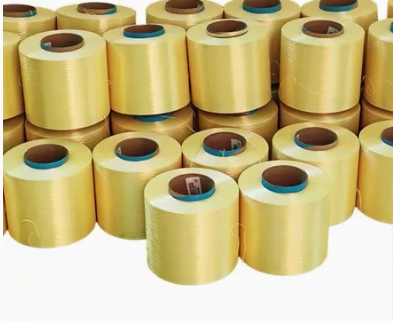
Para-aramid filament yarn or para-aramid continuous filament, represents the primary form in which this high-performance fiber enters industrial manufacturing. Unlike staple fibers cut into short lengths, filament yarn consists of continuous strands that run the entire product length without interruption. This continuous structure maximizes strength translation from individual fibers to finished products.
The manufacturing process produces filaments through spinnerets, creating individual fibers that combine into multifilament yarns. Typical yarns contain hundreds of individual filaments twisted or gathered together. This construction provides flexibility while maintaining the exceptional tensile properties characteristic of para-aramid materials. Filament forms dominate applications requiring maximum strength utilization and consistent mechanical performance.
- Filament vs. Staple Fiber
Continuous filaments offer distinct advantages over staple fibers. The uninterrupted fiber length eliminates strength loss from fiber ends, achieving nearly theoretical material efficiency. Filament yarns provide smoother surfaces and more consistent diameters than spun staple yarns. They generate less lint during processing, important for cleanroom applications. However, staple fibers excel in certain textile processes requiring bulk or specific surface characteristics.
- Filament Count and Denier
Manufacturers produce para-aramid filaments in various sizes, typically measured in denier or tex units. Denier represents grams per 9000 meters of yarn length. Common yarns range from 200 denier for lightweight applications to 3000 denier for heavy reinforcement. Filament count varies from 100 to 1000 or more individual filaments per yarn. The combination of filament size and count determines yarn mechanical properties and processing behavior.
- Twist Level and Yarn Construction
Twist level significantly affects filament yarn performance. Low-twist or zero-twist yarns maximize strength translation to composites by maintaining parallel filament orientation for optimal load sharing. Twisted yarns improve handling and abrasion resistance for textile processes. Balanced twist constructions prevent kinking and snagging during weaving or braiding. Manufacturers optimize twist for specific end-use applications, balancing processability against mechanical performance.
- Surface Characteristics
As-spun para-aramid filaments have smooth surfaces that may limit bonding with matrix materials in composites. Some applications require surface treatment to enhance adhesion. Others benefit from the natural lubricity for textile processing. Surface finishes applied during manufacturing protect filaments during subsequent handling and may be tailored to specific end-use requirements.
Key Applications and Use Cases
Continuous filament yarns serve critical applications where maximum strength utilization and consistent quality are essential. The uninterrupted fiber structure provides advantages in demanding technical applications.
- Optical Cable Strength Members
The telecommunications industry represents a major consumer of para-aramid filament for optical cable reinforcement. Continuous filament yarns provide ideal tensile members, with high modulus preventing cable stretch during installation. The uninterrupted fiber structure ensures consistent reinforcement along entire cable lengths. Multiple yarns combine to achieve required cable strength ratings. Dielectric properties eliminate grounding concerns in all-dielectric cable constructions.
- Composite Reinforcement
Advanced composites use continuous filament yarns for maximum structural performance. Unidirectional composites align filaments parallel to applied loads, achieving exceptional strength-to-weight ratios. Woven fabrics from filament yarns provide multidirectional reinforcement for complex structures. Filament continuity ensures that loads transfer efficiently through the composite without weak points at fiber ends. Aerospace, marine, and automotive applications exploit these characteristics.
Ballistic protection fabrics weave or knit continuous filament yarns into multi-layer structures. Filament continuity maximizes energy absorption during projectile impact, as load transfers along entire fiber lengths. Woven constructions from filament yarns provide consistent performance across armor panels. The smooth filament surface facilitates the tight weaves necessary for effective ballistic resistance.
- Ropes and Cables
High-performance ropes and cables utilize para-aramid filament for exceptional strength-to-weight ratio. Continuous filament construction maximizes strength utilization in tension members. Braided constructions combine multiple yarns into load-bearing ropes for marine, offshore, and industrial applications. Filament continuity eliminates weak points that could initiate failure under cyclic loading.
Performance Characteristics and Specifications
Understanding filament yarn specifications enables proper material selection for specific applications. Manufacturers provide detailed technical data to guide product development.
- Tensile Properties
Para-aramid filament exhibits characteristic tensile behavior with high strength and moderate elongation. Typical tenacity ranges from 20-24 grams per denier, translating to tensile strength of 2.8-3.4 GPa. Initial modulus varies by grade from 400-900 grams per denier. Elongation at break typically measures 2.5-4.0%. These properties remain consistent along the entire filament length due to continuous manufacturing.
- Thermal Performance
Filament yarns maintain mechanical properties at elevated temperatures relevant to many applications. Retention of room-temperature strength exceeds 90% at 200°C. Thermal decomposition begins above 400°C without melting. Coefficient of thermal expansion is slightly negative, meaning filaments contract when heated. This unusual behavior proves valuable in dimensionally critical applications.
- Creep and Stress Relaxation
Para-aramid filaments exhibit excellent creep resistance under sustained load. The highly crystalline structure resists molecular rearrangement that causes creep in many polymers. Stress relaxation under constant strain similarly remains low. These characteristics make filament yarns suitable for long-term tension member applications such as cables and reinforcements.
- Fatigue Resistance
Filament yarns demonstrate good resistance to cyclic loading. The linear molecular structure distributes stress evenly along filament lengths. However, repeated flexing can cause filament breakage through abrasion and inter-filament friction. Proper lubrication and cable design minimize these effects in dynamic applications.
Handling and Processing Guidelines
Proper handling preserves filament integrity through subsequent manufacturing processes. These materials require specific techniques for optimal results.
- Creel Setup and Tension Management
Multiple yarn packages combine in creels for subsequent processing. Maintain consistent tension across all ends to ensure uniform product quality. Over-tension can damage filaments or introduce unwanted stretch. Under-tension allows tangling and processing defects. Electronic tension control systems provide the precision needed for critical applications.
- Splicing and Package Transfer
Continuous processes require package changes without interrupting production. Splicing techniques join filament ends using adhesive or mechanical methods. Proper splices maintain strength while minimizing bulk. Automatic transfer systems switch between packages without stopping production. Splice quality verification ensures continuity of mechanical properties.
- Static Control
Para-aramid filaments generate static electricity during processing. Static charges attract contamination and cause handling difficulties. Antistatic finishes applied during manufacturing reduce charge generation. Additional static elimination equipment may be necessary in dry environments. Conductive tinsel or ionizing bars neutralize charges before they cause problems.
- Storage and Environmental Control
Store filament yarns in controlled environments to maintain properties. Humidity affects fiber moisture content, which influences dimensions and processing behavior. Temperature extremes may affect package stability. Protect from direct UV exposure that could degrade surface properties. Rotate inventory to use older stock first, though properly stored filaments maintain properties indefinitely.
FAQs
1. What is the difference between para-aramid filament and staple fiber?
Para-aramid filament consists of continuous strands running the entire product length, while staple fibers are cut into short lengths typically 2-6 inches long. Filament yarns maximize strength translation by eliminating fiber end defects, achieving higher composite performance. Staple fibers process on conventional textile equipment to create spun yarns with different surface characteristics. Filament dominates technical applications requiring maximum mechanical properties, while staple serves applications where bulk or specific textile qualities matter.
2. How is filament denier related to yarn strength?
Filament denier directly correlates with yarn strength. Denier measures linear density, with higher denier indicating heavier yarns containing more material. Since para-aramid strength is proportional to cross-sectional area, higher denier yarns exhibit proportionally higher breaking strength. However, specific tenacity (strength per denier) remains constant across denier ranges. Selecting appropriate denier balances required strength against yarn size constraints in the final product.
3. Why is filament preferred for optical cable strength members?
Continuous filament provides ideal tensile reinforcement for optical cables because uninterrupted fibers achieve maximum strength translation. The consistent filament diameter and smooth surface enable precise cable design. Filament continuity ensures uniform reinforcement along entire cable lengths without weak points at fiber ends. Additionally, filament yarns generate minimal lint during cable manufacturing, maintaining clean conditions essential for optical performance.
4. How does twist affect filament yarn performance?
Twist level significantly influences filament yarn behavior. Low-twist or zero-twist yarns maximize strength translation to composites by maintaining parallel filament orientation for optimal load sharing. Twisted yarns improve abrasion resistance and handling during textile processes like weaving or braiding. Excessive twist reduces strength by introducing transverse stresses and misalignment. Manufacturers optimize twist for specific applications, balancing processability against mechanical property retention.
Company Introduction: With over 20 years of deep industry expertise, we specialize in customizing and supplying solutions for optical fibers, cables, raw materials, and manufacturing equipment. We deliver reliable technical support and product services.
About the Author: With 20 years of hands-on experience in optical transmission media, cable assemblies, and core substrate materials, we offer practical, expert insights grounded in full-industry-chain expertise.