Shanghai Gengyun Industrial Co., Ltd
What is a High-Efficiency Fiber Coloring Machine?
The Critical Coloring Process in Fiber Manufacturing
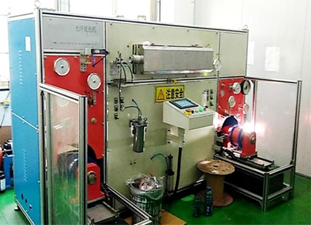
In the production of optical fiber, the downstream coloring step is vital. It enables fiber identification and is essential for later cable management. Leading Fiber Coloring Machine Manufacturers do more than supply basic equipment. Their core value lies in delivering fully integrated, automated production lines. A key module in such systems is the High-Efficiency Automatic Rewinding System. Together, they form a complete, stable, and reliable solution. This integration is the backbone of an efficient modern fiber production workflow.
- The Purpose and Demands of Fiber Coloring
Individual fibers inside a cable look identical. To manage, splice, and maintain them, each one must be marked. This is done by applying a thin, colored coating following a universal standard like TIA-598. The process must be very fast to match the output of the drawing tower. It also requires extreme precision in color ring placement for machine readability. Furthermore, the coating must be highly durable to survive later cabling steps. Therefore, the coloring unit is a critical piece of precision manufacturing equipment. Its performance directly affects the entire supply chain’s efficiency and error rates.
- Evolution Towards Integrated, Automated Lines
Early coloring setups were often semi-automatic. They needed significant manual work for loading, unloading, and quality checks. Modern production demands have pushed the industry toward fully integrated, automated lines. The Automatic Rewinding System is central to this evolution. It creates a continuous, closed-loop process from the fiber source through coloring, curing, and inspection, finally winding the fiber onto a transport spool. This seamless integration is key to achieving the high output, consistent quality, and low loss required for competitive manufacturing today.
Core Technology and Performance Advantages
Advanced fiber coloring machines excel in four key areas: high speed, high precision, minimal added signal loss, and intelligent operation. These are achieved through sophisticated sub-systems working together.
- High-Speed UV Curing and Precision Application
The core coloring module uses UV curing technology. As bare fiber moves at speeds over 3000 meters per minute, a precise metering system applies a controlled amount of colored, UV-curable ink. The fiber then instantly passes under high-intensity UV LED lamps. The ink cures immediately, forming a hard, durable coating. The machine’s controls ensure very high accuracy in the length and position of each color ring. This strict adherence to industry color code standards is critical for reliable identification.
- The High-Efficiency Automatic Rewinding System
This subsystem is the engine for continuous, automated production:
- Pay-Off: It gently unwinds fiber from the input source with minimal tension.
- Traverse & Take-Up: It precisely winds the colored fiber onto large take-up spools. A precision traverse mechanism creates even, cross-wound layers. This prevents fiber digging and allows stable unwinding in the next production step.
- Intelligent Tension Control: This is the most critical feature. Using servo-controlled dancers or sensors, it maintains a consistent, very low tension on the fiber throughout the high-speed path. This precise tension control is vital to avoid introducing microbend loss during winding, which would harm the fiber’s optical performance.
- Automation: The system enables long-term, unattended operation. It automatically manages spool changes, tail tying, and data logging. This dramatically boosts labor productivity and line uptime.
- Intelligence, Quality Control, and Low Loss
Modern equipment integrates in-line monitoring systems. These can include laser gauges to check coating diameter and vision systems to verify color sequence. Some systems may even perform basic attenuation checks. This real-time quality control allows for immediate process adjustment. The combined effect of precise tension control and gentle handling ensures the machine adds very little extra signal loss. This preserves the pristine optical quality of the original drawn fiber.
Application in Production and Strategic Value
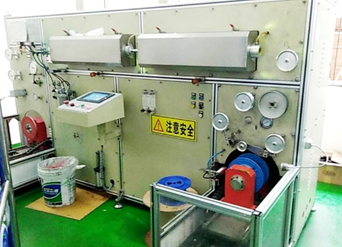
This technology is integral to the global optical fiber supply chain. It plays a specific and vital role in converting raw glass fiber into a manageable, identifiable product.
- Key Production Applications
- In-Line with Drawing Towers: Connected directly to the optical fiber drawing tower. It colors the fiber continuously as it is produced. This is the most efficient method for high-volume standard single-mode fiber production.
- Stand-Alone Coloring Lines: Used for coloring specialty fibers or for re-spooling and re-coloring operations.
- Production for Ribboning: The colored single fibers are the direct input for fiber ribbon lines. Precise coloring is essential for identifying individual fibers within the flat ribbon matrix.
- Delivering Competitive Advantage to Manufacturers
Investing in a high-performance coloring line with an Automatic Rewinding System gives manufacturers direct business benefits:
- Lower Unit Cost: Higher speeds, less manual labor, and higher yield reduce the cost per kilometer produced.
- Superior Product Consistency: Automated precision ensures every fiber meets specification, strengthening brand reputation.
- Enhanced Supply Chain Reliability: High, stable output ensures a dependable feedstock for downstream cabling plants.
- Market Competitiveness: The ability to efficiently produce large volumes of high-quality, low-loss colored fiber is a fundamental competitive edge.
Future Trends: Smart Factories and Advanced Integration
The future of fiber coloring lies in deeper digital integration and smarter process control, moving toward the smart factory vision.
The high-efficiency fiber coloring machine, particularly when integrated with an advanced Automatic Rewinding System, is far more than a marking tool. It is a sophisticated precision manufacturing platform that ensures the identifiability, quality, and handleability of optical fiber at industrial scale. By mastering high-speed UV curing, critical tension control, and automated material handling, this technology directly enables the production of low-loss, reliably identified fiber essential for global communications. As the industry marches toward Industry 4.0, these machines are evolving into intelligent, connected nodes within smart factories, promising even greater efficiency, traceability, and autonomy in the fiber manufacturing process.
FAQs
1. Why is tension control so critical in the rewinding system?
Precise tension control is paramount to prevent microbend loss. Optical fiber is extremely sensitive to minute bends. If tension is too high or fluctuates during winding, the fiber can press into underlying layers on the spool. This creates microscopic bends that scatter light, causing signal attenuation and degrading performance. Advanced systems maintain tension within a very narrow, optimal range (often just a few grams) to preserve the fiber’s intrinsic optical quality.
2. What are the main advantages of UV-LED curing over traditional mercury lamps?
- Energy Efficiency: LEDs convert most electricity into UV light, whereas mercury lamps waste much as heat.
- Instant Operation & Long Life: No warm-up/cool-down; lifetimes exceed 20,000 hours, much longer than mercury lamps.
- Cool Operation: Minimal radiant heat reduces thermal stress on the fiber.
- Precise Wavelength: Emission peak matches the ink’s photoinitiator for efficient curing.
- Environmental & Safety: Contain no toxic mercury, are RoHS compliant, and reduce ozone generation.
3. Does the coloring process affect the fiber’s mechanical reliability?
A properly applied and cured color coating actually enhances mechanical reliability. The UV-cured ink layer adds a protective shell. This increases the fiber’s resistance to microbending and abrasion during later handling and cabling. It does not compromise the underlying fiber strength. The key is a uniform, well-adhered, and fully cured coating, which a high-quality machine is designed to produce.
4. Can one machine handle all fiber types (single-mode, multimode, specialty fibers)?
Most modern high-speed machines are designed for versatility. They can typically process standard single-mode and multimode fibers by adjusting parameters like tension and UV dose. However, fibers with very different diameters or special coatings (e.g., some bend-insensitive fibers) may require specific accessories or parameter sets. It is essential to consult with the equipment manufacturer to ensure the machine is configured for your specific fiber portfolio.
Company Introduction: With over 20 years of deep industry expertise, we specialize in customizing and supplying solutions for optical fibers, cables, raw materials, and manufacturing equipment. We deliver reliable technical support and product services.
About the Author: With 20 years of hands-on experience in optical transmission media, cable assemblies, and core substrate materials, we offer practical, expert insights grounded in full-industry-chain expertise.