
Shanghai Gengyun Industrial Co., Ltd
The Essential Guide to 1×8 UPC/APC Mini Blockless PLC Splitters
The Compact Power Distributor for Modern Optical Networks
Modern fiber optic networks need efficient signal distribution. This is true for large FTTH deployments and dense data center links. The 1×8 UPC/APC Mini Blockless PLC Splitter meets this need perfectly. This advanced optical passive device uses Planar Lightwave Circuit (PLC) technology. It divides one input signal evenly into eight outputs. Its key feature is the innovative “blockless” packaging. This design removes the bulky traditional housing. Therefore, it achieves an ultra-compact form factor. This device is a cornerstone for scalable, high-density networks.
- The Evolution: From Bulky Modules to Miniature Components
A key spec is the connector polish: UPC or APC. This choice manages back-reflection or Return Loss.
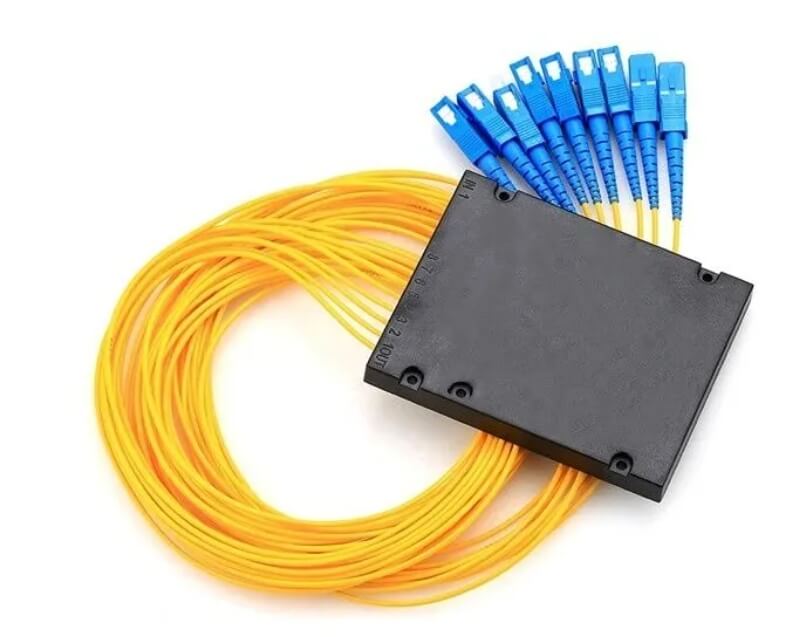
- UPC (Blue Connector): It has a curved end-face for good contact. It offers good return loss (>50 dB). This is the standard for most digital systems like GPON and Ethernet.
- APC (Green Connector): It has an 8-degree angled end-face. This angle scatters reflected light away. So, it achieves superior return loss (>65 dB). It is essential for analog signal transmission like CATV and RF-over-Fiber.
Technical Design and Core Performance Metrics
The mini blockless PLC splitter performs well due to integrated design and precision manufacturing.
- Core Technology: The Planar Lightwave Circuit (PLC) Chip
The device’s heart is a PLC chip. Manufacturers fabricate it on a silica substrate. They use semiconductor photolithography processes. This creates precise, stable optical waveguides. These waveguides split input light with great accuracy. Compared to older FBT technology, PLC offers better wavelength uniformity and temperature stability.
- Key Performance Advantages
- Low Insertion Loss and High Uniformity: These are the main optical metrics. Insertion Loss is the total signal attenuation. Uniformity is the loss variation between outputs. A quality 1×8 splitter has low loss (<10.5 dB) and excellent uniformity (<0.8 dB).
- Exceptional Reliability and Stability: The all-glass waveguide is inherently robust. It resists performance fluctuations. The device stays stable from -40°C to +85°C. This is critical for outdoor and industrial use.
- Compact and Flexible Packaging: The “blockless” design mounts the PLC chip on a substrate. Then, it attaches fibers and adds a protective resin case. This creates a small, durable part for easy integration.
- Critical Specifications for Selection
Engineers check these specs when selecting a splitter:
- Split Ratio: Such as 1×8.
- Wavelength Range: Must cover needed bands like 1310/1550 nm for PON.
- Insertion Loss: Both maximum and typical values.
- Uniformity: The max difference between output channels.
- Return Loss: Differs by polish type (UPC/APC).
- Operating Temperature: The guaranteed performance range.
Applications and Integration in Network Systems
The mini blockless PLC splitter is versatile for many network layers.
- Primary Deployment Scenarios
- FTTH/PON Access Networks: This is the most common use. It fans out a feeder fiber to multiple homes in cabinets or boxes.
- CATV/HFC Networks: APC-type splitters are key here. They distribute analog RF video with minimal distortion.
- 5G Fronthaul/Midhaul: Used in C-RAN architectures. It splits signals to multiple radio units for small cell deployments.
- Data Center Interconnects: Used for signal monitoring or distribution within frames.
- Integration Advantages for Equipment Design
For OEMs, this splitter changes the game:
- Space Savings: Allows high-density line cards and compact CPE like ONUs.
- Design Flexibility: Can be soldered onto a PCB or built into custom assemblies.
- Cost-Effectiveness: Streamlined design and volume manufacturing make it cost-efficient.
Future Trends and Conclusion
Optical networking demands more integration, pushing splitter technology forward.
Future trends point to higher split ratios like 1×32 in small packages. Integration with WDM functions on one chip is advancing. Growth of IoT will drive demand for robust, compact splitters. The push for green networks also favors passive PLC technology.
In conclusion, the 1×8 Mini Blockless PLC Splitter is a masterpiece of optical integration. It fits modern, high-density network needs perfectly. It combines stable PLC technology with a compact form factor. Its dual UPC/APC options serve many applications. This component remains a fundamental block in global optical infrastructure.
FAQs
1. What is the actual difference between a “blockless” splitter and a traditional “module” splitter?
The core difference is packaging. A traditional module houses the PLC chip in a sealed box with ports. A blockless splitter is the bare component with attached fibers. It lacks the external box. You integrate it into a host system like an ODF tray. Blockless splitters save over 80% of the volume.
2. Can I directly connect a patch cord to a mini blockless splitter?
No, not directly. The mini blockless splitter has bare fiber pigtails. You need to fusion splice these to distribution fibers. Or, install them into a tray with adapter ports. It is a component for integration, not a stand-alone box.
3. How do I choose between UPC and APC for my FTTH project?
For standard GPON or XGS-PON with digital data, UPC splitters are adequate and common. Choose APC if your network carries analog RF video signals like CATV. Also choose it for systems needing very low back-reflection. Always follow your network design specifications.
4. Are PLC splitters sensitive to wavelength? Can one splitter work for both 1310nm and 1550nm?
A major PLC advantage is broadband operation. A single standard splitter works from 1260 nm to 1650 nm. So, it works for 1310 nm upstream and 1550 nm downstream simultaneously. It has nearly identical performance for all wavelengths. This is a key benefit over older FBT splitters.
Company Introduction: With over 20 years of deep industry expertise, we specialize in customizing and supplying solutions for optical fibers, cables, raw materials, and manufacturing equipment. We deliver reliable technical support and product services.
About the Author: With 20 years of hands-on experience in optical transmission media, cable assemblies, and core substrate materials, we offer practical, expert insights grounded in full-industry-chain expertise.