
Shanghai Gengyun Industrial Co., Ltd
What are LC Duplex Patch Cables and Why are They Essential for Data Centers?
The High-Speed Interconnect for Modern Data Centers
Modern data centers need reliable, fast connectivity. Servers, switches, and storage must connect efficiently. The LC Duplex Patch Cable meets this need. It uses 50/125 Multimode Fiber and a compact LC duplex connector. This design supports high data rates for short distances inside racks. These cables are key parts of data center structured cabling systems. They directly affect network performance, density, and operational speed.
- The Role of Patch Cables in Data Center Architecture
Data center networks use a structured model. Patch cables are the flexible links in this setup. They connect fixed cables to active equipment ports. So, they complete the optical circuit. Your choice of patch cable matters a lot. Its connector type, fiber type, and performance grade set the maximum speed and reliability. This affects everything from server latency to storage throughput.
- The Dominance of LC and 50/125 Multimode Fiber
The LC connector is now the top choice. It has a small size, a good latch, and great performance. 50/125μm multimode fiber is best for short, fast links. It offers high bandwidth, especially at 850nm. This pair works perfectly with modern optical transceivers like SFP+ and QSFP28. It supports links up to several hundred meters, covering most data center needs.
Technical Specifications and Performance Advantages
An LC Duplex Patch Cable works well because of its precise specs.
- Connector and Fiber Core Technology
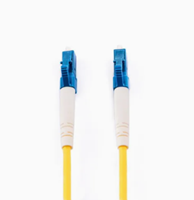
- C Duplex Connector: Its ferrule is very small at 1.25mm. This allows double the port density compared to older SC connectors. The duplex housing manages polarity for transmit and receive channels. Good cables use ceramic ferrules polished to high standards for low loss.
- 50/125μm Multimode Fiber Grades: These follow the OM standard:
- OM3 (Aqua Jacket): Optimized for 10GbE up to 300m.
- OM4 (Violet/Aqua Jacket): More bandwidth for 10/40/100GbE.
- OM5 (Lime Green): Wideband multimode fiber (WBMMF) for SWDM technology, supporting 200G/400G.
- Key Performance Metrics
- Insertion Loss (IL): This is the total signal loss. Good patch cables keep IL below 0.35 dB per link.
- Return Loss (RL): This measures reflected light. High RL keeps lasers stable.
- End-Face Geometry: Manufacturers control this tightly for good contact and durability over 500+ cycles.
- Flame Safety: LSZH jackets are a must. They meet strict fire codes and prevent toxic smoke.
- Bandwidth and Distance Support
Cable performance depends on its fiber grade. A typical OM4 cable supports many standards:
- 10GBASE-SR up to 400m
- 40GBASE-SR4 up to 150m
- 100GBASE-SR4 up to 150m
Applications in Data Center Ecosystems
These patch cables work hard in every network layer.
- Primary Interconnect Scenarios
- Top-of-Rack (ToR) Connectivity: They link servers to the rack switch.
- End-of-Row/Middle-of-Row Links: They connect ToR switches to core switches.
- Spine-Leaf Architecture: They form the fast links between leaf and spine switches.
- Storage Area Network (SAN): They connect servers to storage using Fibre Channel protocols.
- Enabling Network Evolution and Reliability
The right cable is future-proof. Using OM4 or OM5 today gives you bandwidth for tomorrow. You can often upgrade speeds just by changing transceivers, not cables. Also, high-quality factory-made cords ensure reliable, low-error connections. This minimizes downtime and trouble.
Future Trends and Conclusion
Data center speeds keep rising for AI and cloud growth. Patch cable tech must keep up.
The push to 800G Ethernet needs more fibers in one cable (like MPO-to-LC breakouts). It also needs better OM5/WBMMF for SWDM technology. Intelligent cabling is also growing. Cables may get NFC or RFID tags for automated management. Also, bend-insensitive fiber is now standard for tight cable trays.
In conclusion, the LC Duplex Patch Cable is a precision optical part. It links passive infrastructure to active gear. Its small LC connector and fast multimode fiber fit data center needs perfectly. It ensures low loss, high reliability, and support for new standards. These cables form the flexible nervous system for fast data flow. They are indispensable for the world’s digital backbone.
FAQs
1. What is the difference between OM3, OM4, and OM5 patch cables?
The main differences are bandwidth and supported distance. OM3 handles 10GbE up to 300m. OM4 has more bandwidth for 100GbE up to 150m. OM5 is Wideband Multimode Fiber for SWDM. It can support 200G/400G over longer distances than OM4.
2. Can I use a multimode patch cable with a single-mode transceiver?
No, you cannot. Multimode fiber and single-mode fiber are different. They have different core sizes and light transmission. Mismatching them causes major signal loss. Always match your cable’s fiber type to your transceiver’s specs.
3. Why is the jacket color important on a patch cable?
Color is a key visual standard. It helps prevent errors in dense setups.
- Aqua/Violet: 50/125μm Multimode (OM3/OM4).
- Lime Green: OM5 Wideband Fiber.
- Yellow: OS2 Single-Mode Fiber.
- Orange: Older OM1 fiber.
4. Are factory-terminated and field-terminated cords the same?
No, performance differs a lot. Factory-terminated cords are made in controlled settings. They offer guaranteed, consistent low loss and high reliability. Field-terminated connectors are for emergencies. They often have higher, more variable loss. For critical data center links, always choose factory-terminated cords.
Company Introduction: With over 20 years of deep industry expertise, we specialize in customizing and supplying solutions for optical fibers, cables, raw materials, and manufacturing equipment. We deliver reliable technical support and product services.
About the Author: With 20 years of hands-on experience in optical transmission media, cable assemblies, and core substrate materials, we offer practical, expert insights grounded in full-industry-chain expertise.