Shanghai Gengyun Industrial Co., Ltd
PE Plastic Raw Material / Recycled PE Pellets
This article examines why PE plastic raw material remains the default cable jacketing polymer. It analyzes the molecular structure that governs crystallinity and flexibility, the environmental stress crack resistance that determines buried-cable service life, the additive systems that extend durability, and the distinct performance tier occupied by recycled PE pellets. It also compares PE with PVC and LSZH to define where PE wins and where it does not.
Molecular Structure and the Crystallinity–Flexibility Balance
Polyethylene’s properties derive from its chain architecture. The degree of branching determines crystallinity, which in turn governs stiffness, toughness, and moisture barrier performance. Understanding this relationship explains why a single polymer family can serve applications as different as rigid buried power cables and flexible aerial drop cables.
- HDPE, LLDPE, and MDPE: Three Grades, Three Property Profiles
High-density polyethylene (HDPE) has minimal chain branching, producing high crystallinity, high stiffness, and excellent moisture barrier properties. Linear low-density polyethylene (LLDPE) introduces short-chain branching that reduces crystallinity and increases flexibility and toughness. Medium-density polyethylene (MDPE) occupies the middle ground, offering a balance of stiffness and flexibility that suits many cable jacket applications. Cable designers select among these grades based on the mechanical and environmental demands of each installation.
- Why Grade Versatility Simplifies Cable Portfolios
Because one polymer family spans the range from rigid to flexible, cable manufacturers can qualify a single material chemistry across a diverse product line. A buried distribution cable and an aerial drop cable may use different PE grades, but they share the same base polymer family, the same supplier qualification framework, and the same recycling infrastructure. This commonality reduces sourcing complexity and qualification cost compared with switching between chemically distinct polymers for each application.
- The Limits of Density as a Specification
Density alone does not determine performance. Two HDPE resins with the same density can exhibit very different ESCR, processability, and aging behavior because density does not capture molecular weight distribution, comonomer placement, or additive package design. Cable manufacturers therefore qualify resins on accelerated aging data and mechanical testing, not on density and melt index datasheets alone. This distinction explains why commodity HDPE rarely matches cable-grade resin performance even when the headline specifications appear identical.
Environmental Stress Crack Resistance: The Buried-Cable Decisive Property
For direct-buried cables, environmental stress crack resistance (ESCR) is the property that most directly determines service life. Buried cables experience sustained soil pressure, residual installation stress, and thermal cycling for decades. Any stress concentration can initiate slow crack growth that propagates through the jacket over years.
- How Slow Crack Growth Destroys a Jacket
A scratch on the jacket surface, a point load from a rock, or a bend radius violation during installation creates a stress concentration. Under sustained load and moisture exposure, polymer chains at the stress concentration slowly disentangle and break, forming a crack that propagates through the jacket wall. Once the crack penetrates the wall, moisture reaches the metallic shield or insulation, initiating corrosion or water treeing. The jacket’s ESCR rating quantifies its resistance to this slow crack growth process.
- Bimodal Resins and the ESCR Breakthrough
Cable-grade HDPE resins address slow crack growth through molecular design. Bimodal and multimodal resins combine high-molecular-weight chains that resist crack propagation with low-molecular-weight chains that aid processability. The result is a resin that achieves ESCR values above 5,000 hours in standard test conditions while remaining extrudable at commercial line speeds. Commodity HDPE, by contrast, often exhibits ESCR below 1,000 hours, making it unsuitable for buried service regardless of its density or tensile strength.
- Why ESCR Outweighs Tensile Strength in Buried Service
Tensile strength governs short-term pulling loads during installation. ESCR governs whether the jacket survives decades of sustained stress. A high-tensile PE with poor ESCR can fail prematurely in direct-buried service, whereas a moderate-strength grade with high ESCR survives the design life. Consequently, cable specifications for buried applications prioritize ESCR over tensile strength, and suppliers that cannot meet the ESCR threshold are disqualified regardless of other properties.
Additive Systems and the Recycled PE Tier
PE plastic raw material for cable jacketing is never a pure polymer. It incorporates a carefully balanced additive package that extends service life and enables manufacturing. Separately, recycled PE pellets occupy a distinct performance tier with different capabilities and limits.
- Carbon Black, Antioxidants, and Processing Aids
Carbon black at 2.0–2.5% loading provides UV screening for outdoor exposure, preventing chain scission that would otherwise cause surface crazing and jacket cracking within a few years. Antioxidant systems protect the polymer during extrusion and throughout service life, scavenging free radicals that would otherwise degrade the chain structure. Processing aids improve extrusion characteristics, reducing melt fracture and surface roughness at high line speeds. Two resins with identical base polymer specifications can perform very differently in service if their additive systems differ.
- Recycled PE Pellets: Capabilities and Limits
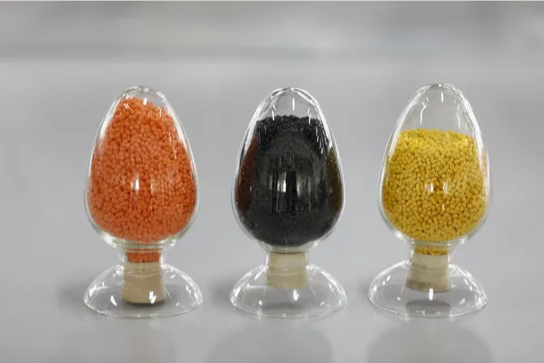
Recycled PE pellets with 50% or higher post-consumer recycled content preserve adequate stiffness and processability for jacket and bedding layers in medium- and low-voltage cables. However, residual impurities—trace metals, residual carbon black, inconsistent molecular weight distribution—impose limits. The industry consensus places recycled PE in jacket and bedding applications, not in primary insulation. For optical cable jackets, recycled PE is generally avoided because residual volatiles may generate hydrogen that increases attenuation at 1383 nm.
- The Dual-Track Market Structure
The performance ceiling of recycled PE restricts its use in the fastest-growing segments—high-voltage transmission and high-fiber-count optical cables—where dielectric purity and low hydrogen generation remain mandatory. Consequently, the market is bifurcating: virgin PE consolidates its position in critical insulation and thin-wall applications, while recycled PE expands in jacket, bedding, and filling roles. This dual-track structure is likely to persist through 2030.
Comparative Advantage: PE vs. PVC vs. LSZH
PE competes with PVC and LSZH compounds across the cable jacketing market. Each material occupies a distinct position defined by cost, fire safety, and mechanical performance.
- PVC: Low Cost, High Toxicity
PVC costs less than PE and offers inherent flame retardancy, but it produces dense black smoke and corrosive hydrogen chloride gas when burned. In enclosed spaces, this toxicity is a serious liability. PVC retains a foothold in cost-sensitive indoor applications where codes permit it, but it is increasingly displaced by LSZH in occupied buildings.
- LSZH: Fire Safety at a Premium
LSZH compounds solve the toxicity problem but cost more and typically exhibit lower mechanical strength and abrasion resistance than PE. They are mandatory in indoor plenum and riser spaces where fire safety codes apply. In outdoor and buried applications where flame retardancy is not the governing requirement, LSZH’s premium price is not justified by its performance.
- The Application Boundary That Defines PE’s Position
PE wins on cost and durability where flame retardancy is not the governing requirement. It loses to LSZH in indoor plenum and riser spaces where smoke toxicity is the decisive factor. PVC retains a niche in cost-sensitive indoor applications. Consequently, PE’s market position is strongest in outside-plant power and optical cables, and weakest in occupied indoor spaces—a boundary that is stable and unlikely to shift as long as fire codes mandate low-smoke materials indoors.
FAQs
1. Why does ESCR matter more than tensile strength for buried cables?
Buried cables experience sustained soil pressure and residual installation stress for decades. Tensile strength governs short-term pulling loads, but ESCR determines whether slow crack growth initiates at stress concentrations. A high-tensile PE with poor ESCR can fail prematurely in direct-buried service, whereas a moderate-strength grade with high ESCR survives the design life.
2. Can recycled PE pellets fully replace virgin PE in cable jackets?
For thick-wall jackets in medium- and low-voltage cables, recycled PE can replace virgin material at 30–50% loading with proper filtration and source control. However, thin-wall, high-voltage, and hydrogen-sensitive optical cable jackets still require virgin PE because trace impurities and residual outgassing risk compromise dielectric performance and optical attenuation.
3. How does carbon black content affect PE jacket performance?
Carbon black at 2.0–2.5% provides effective UV screening for outdoor exposure. Below 2.0%, UV penetration degrades the polymer chain, causing surface crazing and jacket cracking. Above 3.0%, the compound becomes stiff and difficult to extrude uniformly, and the excess filler can reduce ESCR by acting as stress concentrators.
4. Why do two HDPE resins with the same density and melt index perform differently in service?
Because density and melt index do not capture molecular weight distribution, comonomer placement, or additive package design. Bimodal resins with tailored chain architecture achieve higher ESCR than unimodal resins at the same density. Additive systems determine UV and thermal aging performance. Cable manufacturers qualify resins on accelerated aging data, not just physical property datasheets.
Company Introduction: With over 20 years of deep industry expertise, we specialize in customizing and supplying solutions for optical fibers, cables, raw materials, and manufacturing equipment. We deliver reliable technical support and product services.
About the Author: With 20 years of hands-on experience in optical transmission media, cable assemblies, and core substrate materials, we offer practical, expert insights grounded in full-industry-chain expertise.