
Shanghai Gengyun Industrial Co., Ltd
What Are High-Precision Fiber Arrays and How Do They Enable Advanced Optical Systems?
The Critical Bridge in Modern Photonics
In the world of advanced photonics, devices like planar lightwave circuits (PLCs), coherent transceivers, and silicon photonic chips form the brains of modern optical networks. However, these powerful chips need a reliable, low-loss connection to the outside world—the optical fiber. Specifically, connecting multiple, hair-thin glass fibers to microscopic waveguides on a chip with nanometer-scale alignment is a key technical challenge. Fortunately, high-precision fiber arrays solve this critical interface problem. They act as the fundamental bridge, enabling light to flow efficiently between the fiber optic network and complex integrated photonic circuits. Consequently, their performance directly dictates the efficiency, cost, and reliability of the entire optical system.
- The Core Challenge: Alignment at the Micron Scale
The fundamental hurdle is optical coupling efficiency. The core of a standard single-mode fiber is about 9 microns in diameter, while the wave guides on a photonic chip can be even smaller. To achieve low insertion loss, the centers of these two light-carrying structures must align with extraordinary precision—often to within less than one micron. Any misalignment, tilt, or gap causes light to scatter, leading to signal loss, cross-talk, and device failure. Manually aligning and fixing multiple fibers to a chip is impractical for mass production. The fiber array provides a pre-aligned, stable, and passive solution to this daunting assembly task.
- Defining High Reliability and Precision
For these components, “precision” and “reliability” have very specific, critical meanings for system designers:
- Precision: Primarily, this means ultra-tight control over the geometric position of each fiber core. Key parameters include lateral core alignment (X, Y position), pitch (distance between adjacent fibers), and end-face angle (typically 8° to minimize back-reflection). Ultimately, this precision ensures optimal optical coupling from installation.
- Reliability: In essence, the component’s optical and mechanical performance must remain stable for decades under real-world stresses. This includes surviving temperature cycling, high humidity, mechanical vibration, and long-term optical power exposure without any degradation.
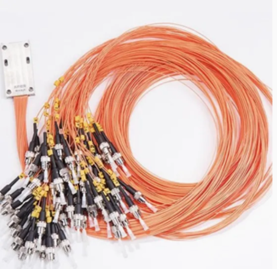
Technical Deep Dive:Design, Fabrication, and Performance
The exceptional capabilities of a high-performance fiber array result from meticulous design, advanced materials, and controlled manufacturing processes.
- Core Construction: The V-Groove Substrate
The heart of a fiber array is its substrate, most commonly made of silicon, glass, or ceramic. Typically, manufacturers etch or precision-machine this substrate with a series of V-shaped grooves. Importantly, the geometry of these grooves determines the final fiber pitch (e.g., 127 µm for 1×4 arrays, 250 µm standard). Next, each stripped optical fiber sits in a corresponding V-groove. Overall, this design naturally aligns the fibers vertically and provides a stable reference plane. For more complex designs, multi-row arrays use a stacked or matrix-based groove design.
- The Precision Assembly and Bonding Process
Assembly is a delicate, cleanroom process:
- First, Fiber Preparation: Technicians strip fibers of their protective coating with micron-level cleanness.
- Then, Active or Passive Alignment: For highest precision, fibers may undergo active alignment—light is injected, and their position adjusts in real-time to maximize coupling to a test waveguide before fixing. Alternatively, passive alignment relies solely on the mechanical precision of the grooves.
- Following this, Bonding and Fixation: Workers apply a specialized optical adhesive. Notably, this epoxy is carefully selected for long-term stability, matching coefficient of thermal expansion (CTE), and low shrinkage during curing. Furthermore, the curing process (often UV or thermal) is tightly controlled to prevent stress-induced movement.
- Finally, End-Face Finishing: The entire assembly undergoes precision grinding and polishing to create a perfectly flat or angled end-face (e.g., 8° Angle Physical Contact). Critically, this step minimizes back-reflection (Return Loss >55 dB) and ensures a clean optical interface.
- Quantifying Performance: Key Specifications
The quality of a fiber array is measured by several key parameters:
- Insertion Loss (IL): The total optical power lost when coupling through the array. For example, high-precision arrays achieve typical IL < 0.5 dB per channel.
- Uniformity: The variation in IL between different channels in the same array (e.g., < ±0.3 dB), which is vital for multi-channel systems.
- Pitch Accuracy: Deviation from the nominal fiber-to-fiber spacing (e.g., 250 µm ± 0.5 µm).
- Core Positional Tolerance: The maximum deviation of any fiber core from its ideal X, Y position, often < ±0.5 µm.
- Thermal Stability: The change in IL over a specified temperature range (e.g., -40°C to +85°C), which should be minimal (< 0.2 dB).
Applications and System-Level Impact
Fiber arrays are not standalone components; rather, they enable entire classes of advanced optical systems and devices.
- Enabling Key Photonic Devices
- PLC-based Splitters and AWGs: Fiber arrays provide the standard interface for connecting to Arrayed Waveguide Gratings (AWGs) used in DWDM multiplexers, and to PLC splitters for passive optical networks (PON).
- Coherent Optical Transceivers: High-speed 400G/800G coherent modules use fiber arrays to connect the integrated silicon photonics IC to the output fibers, thereby managing both signal and local oscillator paths.
- Optical Switches and Interconnects: They form the input/output ports for MEMS-based or thermo-optic optical switches in data center and telecom applications.
- LiDAR and Sensing Systems: In solid-state LiDAR and fiber optic sensing arrays, they enable the precise optical interface between emitters, detectors, and sensor fibers.
- Strategic Value in System Manufacturing
Incorporating a pre-aligned fiber array provides immense value at the system integration level:
- First, it Dramatically Reduced Assembly Complexity and Time: By eliminating the need for painstaking individual fiber alignment, it enables scalable manufacturing.
- Second, it leads to Improved Yield and Consistency: Thus, it delivers repeatable, high-performance coupling, boosting final module production yield.
- Moreover, it provides Enhanced System Reliability: The robust, monolithic structure is far more resistant to environmental shocks and aging than individually glued fibers.
- Finally, it Facilitates Miniaturization: This allows dense, multi-channel optical interfaces to integrate into increasingly small form-factor packages, such as QSFP-DD transceivers.
Future Trends and Conclusion
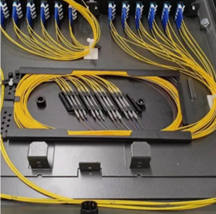
The future of fiber arrays is intertwined with the evolution of photonic integration, pushing towards higher density, broader functionality, and smarter integration.
As photonic chips move towards higher channel counts (e.g., for co-packaged optics and Terabit transceivers), fiber arrays must evolve to support higher fiber density (smaller pitch) and more fiber rows. Consequently, this requires breakthroughs in nanometer-precision dicing and collective alignment techniques. Furthermore, the rise of heterogeneous integration—combining lasers, modulators, and detectors on a single chip—will demand arrays with integrated micro-lenses or spot-size converters to manage different optical mode fields efficiently. Looking ahead, we are also moving towards “smart” arrays that may incorporate embedded monitoring elements, such as micro-sensors for temperature or strain, for health management of the optical link.
In summary, high-precision optical fiber arrays are essential to the photonics revolution.
FAQs
1. What is the difference between passive and active alignment in fiber array manufacturing?
Passive alignment relies entirely on the mechanical precision of the V-groove substrate. Workers place the fibers in the grooves and bond them, trusting that the inherent mechanical tolerances will ensure proper optical alignment. This method offers faster processing and lower cost, making it suitable for high-volume, standardized products. In contrast, active alignment involves a more detailed process. Technicians inject light into the fiber and monitor the output from the chip waveguide or a test structure during assembly. They then adjust the fiber position in real-time to maximize optical coupling before curing the adhesive. This method achieves the highest possible precision and lowest loss, but its greater complexity and time consumption typically reserve it for ultra-high-performance or custom applications.
2. Why are materials like silicon and ceramic preferred for the substrate?
Silicon and ceramic provide a critical combination of essential properties for high-performance substrates. Their exceptional micro-machinability allows manufacturers to create highly precise V-grooves. Additionally, their coefficient of thermal expansion (CTE) can be closely matched to the optical fibers and adhesives, a key feature that minimizes thermal stress. These materials also offer high thermal conductivity for effective heat management and excellent long-term dimensional stability. Moreover, silicon leverages mature semiconductor fabrication techniques, which ensures very high precision and consistency in mass production.
3. Can fiber arrays be reworked or repaired if one fiber is damaged?
Reworking or repairing standard monolithic fiber arrays is extremely challenging. In these designs, workers bond and polish all fibers together as a single block, making individual fiber replacement virtually impossible without jeopardizing the entire assembly’s critical alignment and end-face quality. Therefore, if one fiber sustains damage, technicians typically must replace the entire array unit. This reality underscores the paramount importance of initial manufacturing quality and careful handling. While some specialized designs might permit limited rework, this capability is not standard for most high-precision commercial products.
4. How does the choice of end-face angle (0° vs. 8°) impact performance?
The end-face angle significantly influences optical performance. A 0° (flat) polished end-face is simpler to produce but has a drawback: it can suffer from Fresnel reflections at the glass-air interface. These reflections lead to higher back-reflection, which can destabilize sensitive lasers. Conversely, an 8° Angle Polish effectively deflects any reflected light out of the fiber core, achieving very high return loss (typically >55 dB). This feature is critical for applications involving sensitive lasers, such as in transceivers or analog RF-over-fiber links.
Company Introduction: With over 20 years of deep industry expertise, we specialize in customizing and supplying solutions for optical fibers, cables, raw materials, and manufacturing equipment. We deliver reliable technical support and product services.
About the Author: With 20 years of hands-on experience in optical transmission media, cable assemblies, and core substrate materials, we offer practical, expert insights grounded in full-industry-chain expertise.