
Shanghai Gengyun Industrial Co., Ltd
19-Inch Rack Mount MPO Fiber Patch Panel
MPO Patch Panels
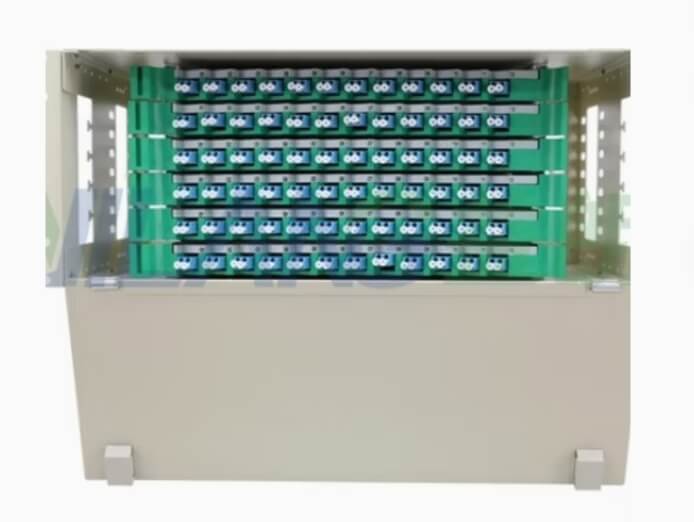
The 19-inch rack mount MPO fiber patch panel enables high-density fiber connections in data centers. This panel accepts MPO cassettes or direct MPO adapter plates. The 19-inch width fits standard equipment racks worldwide. MPO connectors pack 8, 12, or 24 fibers into a single interface. Network operators use these panels to manage backbone and horizontal cabling efficiently.
- MPO Connector Overview
MPO stands for multi-fiber push-on, a high-density connector type. The connector body holds an array of fibers in a single ferrule. Alignment pins ensure precise fiber-to-fiber mating. MPO connectors are keyed to prevent incorrect orientation. This connector type is essential for 40G, 100G, and 400G applications.
- Rack Mount Design Features
Standard 19-inch width allows installation in any equipment rack. Panel height is measured in rack units (1U = 44.5mm). Typical panels occupy 1U to 4U depending on port count. Front access allows patching and cable management. Rear cable management guides protect fiber bend radii.
Key Applications and Use Cases
MPO patch panels serve critical functions in high-speed networks. Each application leverages the density advantage of MPO.
- Data Center Spine-Leaf Architecture
Modern data centers use spine-leaf topologies with many fiber connections. MPO panels connect leaf switches to spine switches efficiently. A single 1U panel can terminate hundreds of fibers. This density supports the massive interconnect requirements. Scalability is built into the MPO panel design.
- Parallel Optics Transmission
40G and 100G Ethernet use parallel optics with multiple fiber pairs. MPO connectors match this parallel transmission perfectly. The panel organizes MPO trunk cables to equipment connections. Breakout cassettes convert MPO to individual LC or SC connectors. This flexibility supports mixed equipment environments.
Performance Specifications
Several parameters define MPO patch panel quality. Understanding these helps buyers select appropriate products.
- Insertion Loss and Return Loss
MPO connector loss depends on ferrule quality and fiber alignment. Typical insertion loss ranges from 0.35 to 0.75 dB per connection. Return loss for single-mode MPO should exceed 50 dB. Multimode MPO specifications focus on insertion loss only. Premium panels use polished and tested MPO components.
- Polarity Management Methods
MPO cabling requires careful polarity management. Method A uses key-up to key-down straight connections. B, uses key-up to key-up with fiber pair flipping. C, uses pair-wise flipping for parallel transmission. The patch panel must support the chosen polarity scheme. Clear labeling prevents polarity errors during installation.
Installation and Maintenance
Proper installation ensures reliable MPO panel performance. Following these guidelines prevents common problems.
- Cable Management Best Practices
Maintain minimum bend radius for MPO trunk cables. Use horizontal and vertical cable managers adjacent to panels. Do not over-tighten cable ties around MPO bundles. Leave service loops for future reconfiguration. Organized cabling simplifies troubleshooting and changes.
- Cleaning and Inspection Procedures
MPO connectors must be clean for low loss operation. Use cassette-style cleaners designed for MPO end faces. Inspect using MPO-specific microscope adapters. Clean both plug and adapter ports before connection. Contamination is the leading cause of MPO performance issues.
FAQs
1. How many fibers can a 1U MPO panel support?
A 1U panel typically supports 72 to 144 fibers. This uses 6 to 12 MPO ports with 12 fibers each. Some high-density panels achieve 216 fibers using 24 MPO ports. The limit depends on cable management space in the rack. Higher density requires careful attention to bend radius protection.
2. Can I mix single-mode and multimode MPO components in the same panel?
Physical mixing is possible but not recommended. Color coding helps distinguish single-mode (blue) from multimode (aqua). Accidental cross-connection can cause high loss. Maintain separate panels for each fiber type. Clear labeling and segregation prevent costly mistakes.
3. What tools are needed for MPO panel installation?
MPO-specific cleaning tools are essential. An MPO inspection microscope with appropriate adapter is required. A fiber identifier helps verify connectivity. Standard hand tools for rack mounting are also needed. No special termination tools are required for factory-terminated MPO cables.
Company Introduction: With over 20 years of deep industry expertise, we specialize in customizing and supplying solutions for optical fibers, cables, raw materials, and manufacturing equipment. We deliver reliable technical support and product services.
About the Author: With 20 years of hands-on experience in optical transmission media, cable assemblies, and core substrate materials, we offer practical, expert insights grounded in full-industry-chain expertise.