
Shanghai Gengyun Industrial Co., Ltd
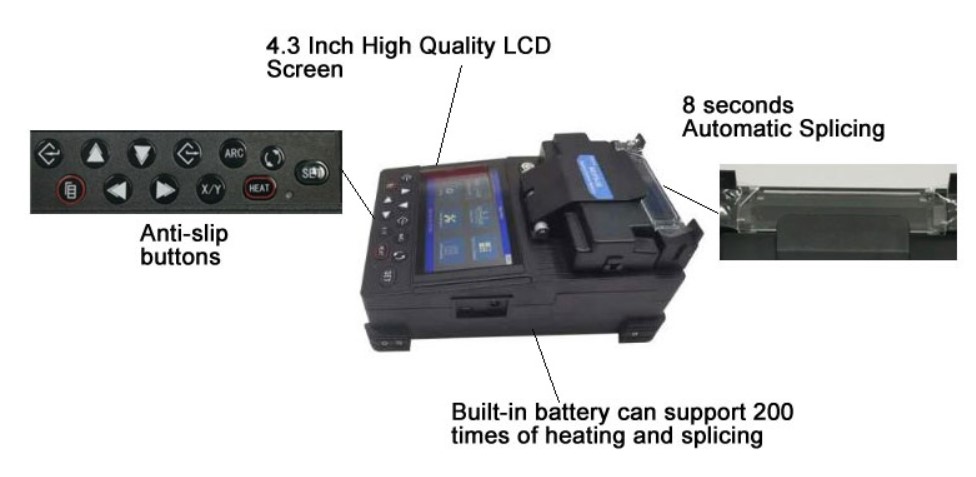
High Precision Ribbon Fiber Fusion Splicer
Introduction to Ribbon Splicers The high precision ribbon fiber fusion splicer splices multiple fibers simultaneously. This machine aligns and fuses entire ribbons of 4, 8, or 12 fibers in one operation. Mass fusion dramatically increases splicing speed compared to single-fiber splicing. High precision ensures low loss across all fibers in the ribbon. Network operators use these splicers […]
Introduction to Ribbon Splicers
The high precision ribbon fiber fusion splicer splices multiple fibers simultaneously. This machine aligns and fuses entire ribbons of 4, 8, or 12 fibers in one operation. Mass fusion dramatically increases splicing speed compared to single-fiber splicing. High precision ensures low loss across all fibers in the ribbon. Network operators use these splicers for high-fiber-count cable installations.
- Ribbon Fiber Overview
Ribbon fiber consists of 4 to 12 fibers arranged in a flat array. The fibers are bonded together with a common matrix material. Color coding identifies each fiber position in the ribbon. Ribbon cables offer higher density than loose tube designs. Mass fusion is the preferred termination method for ribbon fiber.
- Mass Fusion Advantages
One splice event completes all fibers in the ribbon. This reduces splice time by 80-90% compared to single splicing. Lower handling reduces fiber breakage risk. Consistent splice quality across the ribbon is achieved. Mass fusion is essential for high-volume cable installation.
Key Applications and Use Cases
Ribbon splicers serve high-fiber-count network scenarios. Each application benefits from mass fusion speed.
- Long-Haul Backbone Cables
Backbone cables contain 144 to 1728 fibers. Splicing each fiber individually would take days. Ribbon splicing completes the job in hours. The precision alignment ensures low loss for long-distance transmission. Backbone installation efficiency improves dramatically.
- Data Center Structured Cabling
Data centers use ribbon fiber for high-density connections. MPO connectors terminate ribbon fibers efficiently. Ribbon splicers prepare cables for MPO termination. Mass splicing reduces installation time significantly. Data center speed-to-service improves with ribbon technology.
Performance Specifications
Several parameters define ribbon splicer quality. Understanding these helps buyers select appropriate equipment.
- Splice Loss and Estimation
Typical splice loss for single-mode ribbon is under 0.05dB. Loss is estimated from core alignment during fusion. Individual fiber loss can be verified with OTDR. Multi mode ribbon splicers have higher loss specifications. Splice loss consistency across ribbon positions is important.
- Alignment and Cleave Requirements
Core alignment splicers offer lowest loss for single-mode fiber. Cladding alignment is sufficient for multimode applications. Cleave angle must stay below 1 degree for all fibers. Ribbon cleavers prepare all fibers simultaneously. Proper cleaving is essential for low-loss splicing.
Operation and Maintenance
Proper operation ensures splicer performance. Following these guidelines maintains splice quality.
- Electrode Maintenance
Fusion electrodes wear out after 1000-3000 splices. Replace electrodes when splice loss increases. Clean electrodes regularly to remove glass deposits. Calibrate after electrode replacement. Electrode maintenance is critical for consistent splices.
- V-Groove Cleaning
Dirt in V-grooves causes fiber misalignment. Clean V-grooves after every splicing session. Use alcohol and cleaning swabs designed for V-grooves. Inspect under magnification for debris. Clean V-grooves are essential for precision alignment.
FAQs
1. How many fibers can be spliced at once with a ribbon splicer?
Most ribbon splicers handle 4, 8, or 12 fiber ribbons. Some models support 16 or 24 fiber ribbons. The machine must match the ribbon width. Single fiber splicing is still possible with ribbon splicers. Choose a splicer that matches your ribbon types.
2. What is the typical splice time for a 12-fiber ribbon?
Total splice cycle time is typically 20-40 seconds. This includes alignment, fusion, and loss estimation. Preparation time for cleaving and loading adds 1-2 minutes. Overall, mass fusion is 5-10 times faster than single splicing. Productivity gains are substantial for high-fiber-count cables.
3. Can ribbon splicers splice different fiber counts?
Most splicers work with 4, 8, and 12 fiber ribbons. The machine automatically detects the ribbon width. Different cleavers may be needed for different widths. The V-groove spacing is fixed for the ribbon standard. Always verify compatibility with your ribbon types.
Company Introduction: With over 20 years of deep industry expertise, we specialize in customizing and supplying solutions for optical fibers, cables, raw materials, and manufacturing equipment. We deliver reliable technical support and product services.
About the Author: With 20 years of hands-on experience in optical transmission media, cable assemblies, and core substrate materials, we offer practical, expert insights grounded in full-industry-chain expertise.